
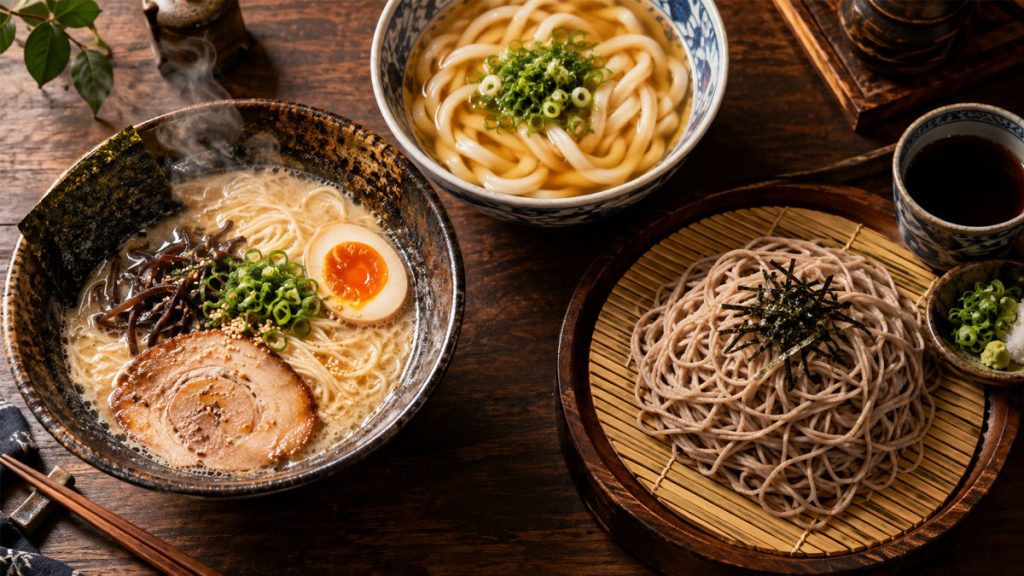
Japan has one of the richest noodle cultures in the world, offering bowls of comfort that range from rich, savory broths to light, earthy, refreshing dishes. When staring down a Japanese restaurant menu, choosing between the heavy hitters can be tricky. While they all belong to the noodle family, ramen, udon, and soba are entirely different culinary worlds defined by unique flours, distinct textures, and specialized broths.
Understanding what sets these three noodle powerhouses apart will help you pick the perfect bowl for any craving or season.
Ramen: The Rich, Comforting Bowl of Wheat Noodles
Ramen is perhaps the most globally famous Japanese noodle dish, celebrated for its deeply complex broths and comforting nature.
- The Noodle: Ramen noodles are made from wheat flour, water, salt, and an alkaline solution called kansui. This special mineral water gives ramen its characteristic yellowish hue, firm bounce, and elastic chew.
- The Broth: The soul of ramen lies in its broth, which is simmered for hours—sometimes days—to extract maximum flavor. The four main styles are shoyu (soy sauce), shio (salt), miso (fermented soybean paste), and tonkotsu (rich, cloudy pork bone broth).
- The Experience: Ramen is typically served piping hot, loaded with toppings like tender chashu pork, a soft-boiled ajitsuke tamago egg, bamboo shoots (menma), and nori. It is a hearty, deeply savory meal best enjoyed year-round.
Udon: Thick, Chewy Comfort Food
If you are looking for pure, comforting texture, udon is the ultimate choice. These are the thickest noodles in the Japanese culinary canon.
- The Noodle: Udon noodles are crafted from simple wheat flour, water, and salt. Because they do not use alkaline water, they are stark white, thick, and plush. The defining characteristic of great udon is its remarkable chewiness—often described as having a pleasant “bounce” or mochi-mochi texture.
- The Broth: Udon is traditionally served in a clear, delicate broth called kakejiru, which is built on a foundation of dashi (fish and kelp stock), soy sauce, and sweet rice wine (mirin).
- The Experience: Udon is incredibly versatile. It can be served hot in a steaming soup during winter (kake udon) or chilled with a savory dipping sauce during sweltering summer months (zaru udon). It is heavy, comforting, and deeply satisfying.
Soba: Earthy, Nutritious, and Delicate
For a lighter, more artisanal experience, soba noodles offer a completely different flavor profile rooted in Japanese tradition.
- The Noodle: Soba translates directly to buckwheat. These thin, grayish-brown noodles are made from buckwheat flour (or a blend of buckwheat and a small amount of wheat flour for binding). Because buckwheat lacks gluten, true soba requires immense skill to roll and cut without breaking.
- The Flavor: Unlike the neutral, wheat-forward taste of ramen and udon, soba has a distinct, earthy, nutty flavor that comes straight from the grain.
- The Experience: Soba is often considered a refined, elegant dish. In the summer, it is served cold on a bamboo mat (zaru soba) with a concentrated dipping sauce (tsuyu) and fresh wasabi. In the winter, it is served hot in a clear broth. Soba is also traditionally eaten during Japanese New Year (Toshikoshi Soba) to symbolize longevity.
How to Choose Your Noodle Bowl
With so many options, deciding what to order comes down to your mood and the weather:
- Choose Ramen when you want a rich, heavy, deeply savory meal packed with complex umami flavors.
- Choose Udon when you are craving comforting, thick, chewy noodles in a clean, soothing broth.
- Choose Soba when you prefer a lighter, nutty, health-conscious meal that highlights traditional artisan craftsmanship.